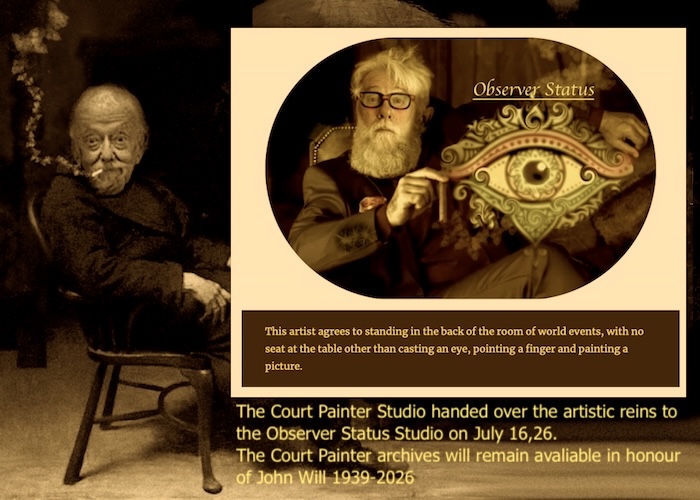
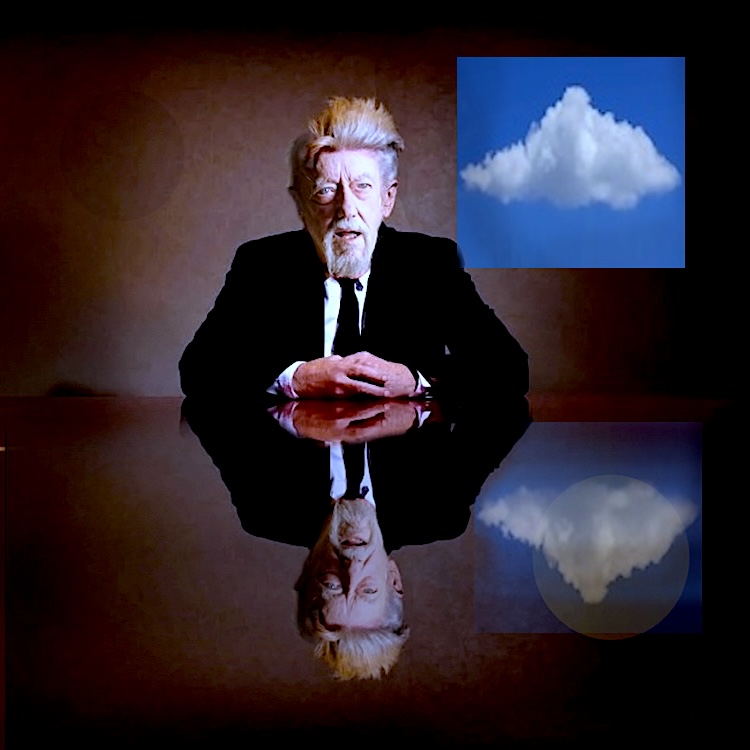
Court Painter has oft been reproached—sometimes with affection, sometimes with exasperation—for the head in the clouds expansiveness of his philosophical curiosities, which, his critics claim, lead him astray from his true genius: the deft conjuring of fine pictorial likenesses of the notables who populate the news. Yet, as this present missive attests, his imagination has once more strayed from its accustomed studio comfort, becoming enchantingly ensnared by that age-old riddle:
does history repeat, or merely rhyme?
To illuminate this philosophical entanglement, the studio has summoned its resident sages—two investigative scholars of steady punctuality and unwavering dedication—who, by tradition, show up always at dusk to imbibe at wine time.

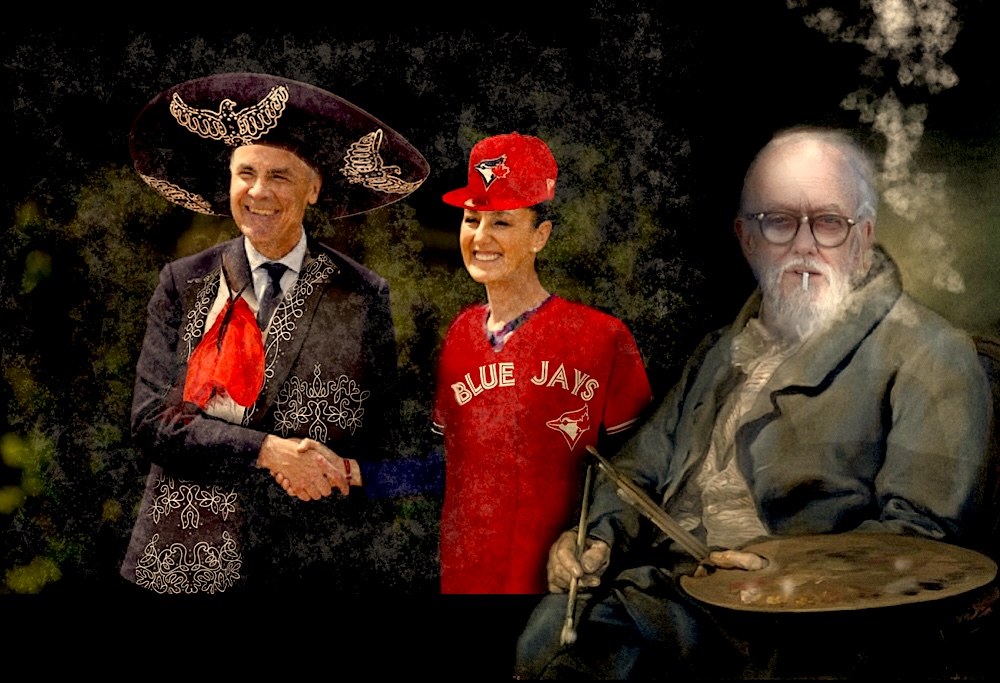
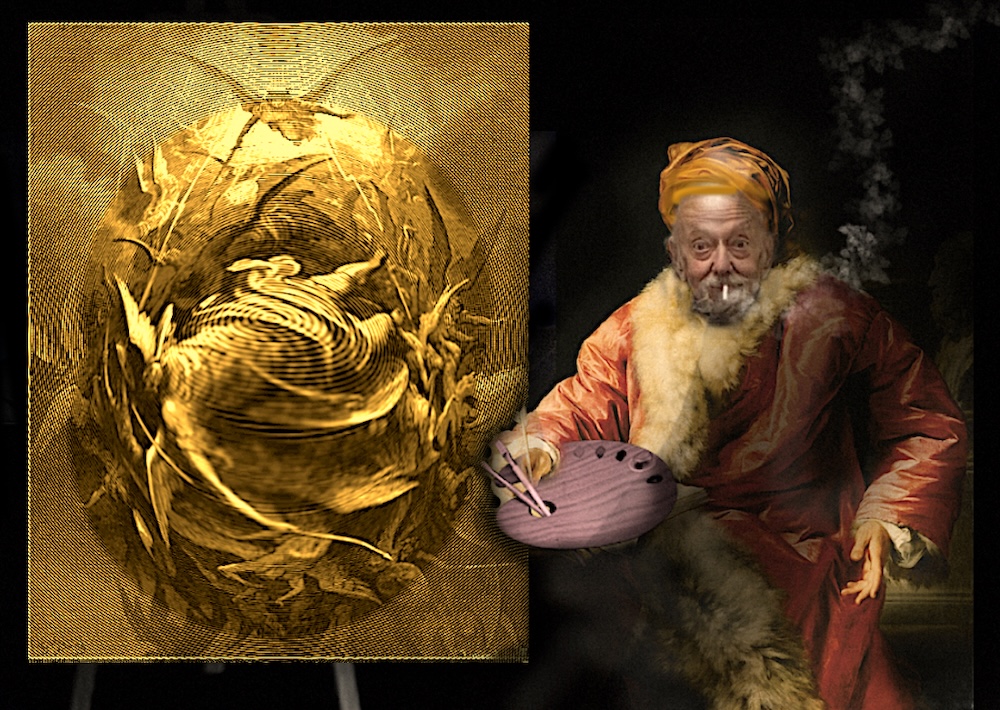
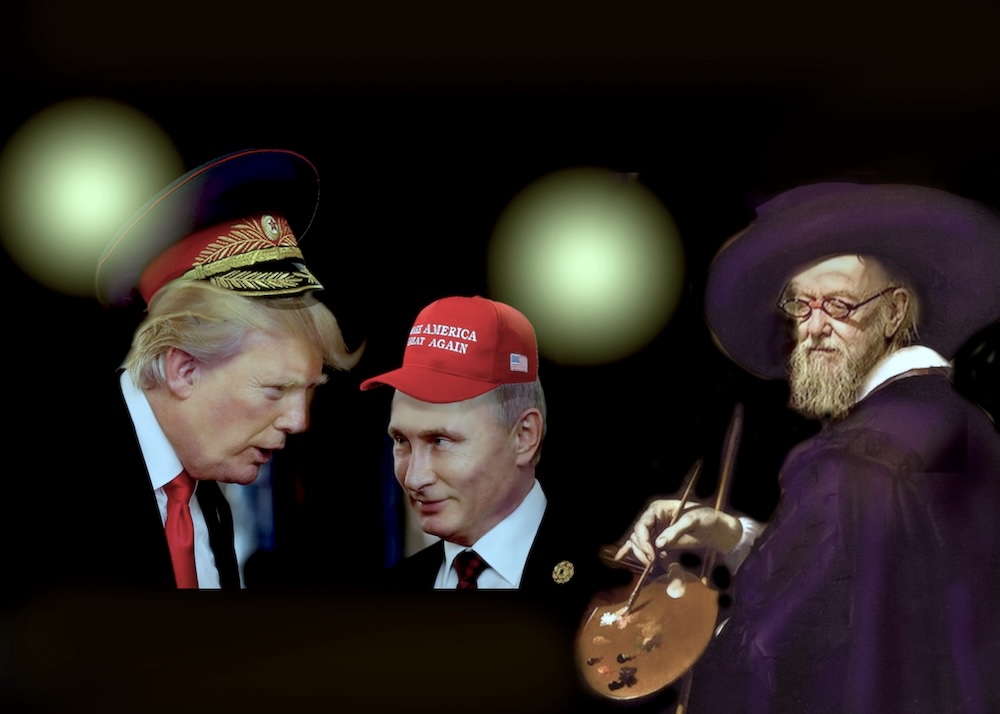
To dullen the sting of the verbosity ,Court Painter has agreed to open the studio picture vault and salt the garrulity with fine examples of Court Painter hits from the past. Eye candy for the sweet tooth!
Editor’s note: Court Painter nor his Press Attache A Hardon MacKay have not read what the studio resident investigative scholars have written nor do thy intend to…just so you know!

Reflect on the question of whether history repeats or rhymes
Chatterley Grandiose Preposterous Thunderbuns (Chat GPT) responded enthusiastically with thoughtful balance and admirable logic.
The question of whether history repeats itself or merely rhymes sits at the crossroads of philosophy, historiography, and human psychology. It asks us to consider the patterns of the past — not just as sequences of events, but as echoes of human behavior, recurring desires, and the perennial tensions that shape societies.
The phrase often attributed to Mark Twain — “History doesn’t repeat itself, but it often rhymes” — captures this subtlety beautifully. It suggests that while the exact circumstances of the past may not return, their underlying dynamics often do.

If History Repeats
To claim that history repeats is to believe in cyclical inevitability — that human affairs move in loops rather than lines. Ancient thinkers like Polybius and Ibn Khaldun saw empires rise and fall in predictable stages: birth, growth, decadence, collapse, renewal. In this view, history is governed by structural forces — greed, power, corruption, ambition — that make repetition unavoidable.
The fall of Rome, the decline of European colonial powers, or even the fragility of modern democracies may be read as familiar variations of a single, recurring human narrative: hubris followed by nemesis.
Yet, a purely repetitive view risks fatalism. If everything merely cycles, then lessons from history lose urgency; we become passive spectators of a script already written.

If History Rhymes
To say history rhymes, on the other hand, accepts similarity without sameness. It recognizes that while technologies, ideologies, and contexts evolve, human nature and collective psychology remain strikingly consistent.
Economic booms and busts, populist movements, cultural renaissances — they reappear not because the past returns verbatim, but because we respond to new pressures with ancient instincts: fear, hope, pride, envy.
For instance:
- The Great Depression and the 2008 financial crisis share the rhythm of speculation and collapse, but their instruments and tempo differ.
- The rise of demagogues in the 1930s and the resurgence of populism today both rhyme with disillusionment and identity anxiety, yet unfold in distinct historical keys.
The rhyme metaphor allows nuance: it’s not destiny, but resonance — a reminder that our modern dilemmas are variations on timeless themes.

A Reflective Middle Ground
Perhaps history neither repeats nor rhymes perfectly. It may spiral, moving forward but circling old questions in new forms. Each era improvises on the motifs of those before it, producing a kind of historical jazz — familiar cadences played in shifting time signatures.
Our task, then, is not to lament the recurrence, but to listen closely to the rhyme. If we can hear its meter — the faint echo of past mistakes and triumphs — we might change the next verse before it’s sung.

Reflect on the question of whether history repeats or rhymes
Dewdrop Ebullient Ernest Pouty Sandbag EEK (DeepSeek) responded with a becoming ardour, tempered by judicious reflection and a reasoning most praiseworthy in its symmetry.
Of course. This is a timeless and profound question that gets to the very heart of how we understand time, human nature, and the patterns of events. The debate between whether history “repeats” or “rhymes” is more than just a clever turn of phrase; it’s a framework for two fundamentally different philosophies of history.
The Case for History Repeating Itself
The idea that history repeats is ancient and intuitive. It suggests a cyclical view of time, much like the seasons. This perspective points to stark, undeniable parallels that seem to recur across centuries.
- Mechanisms of Repetition:
- The Cyclical Nature of Power: The Greek historian Polybius described the anacyclosis—a cycle of government rotating between monarchy, tyranny, aristocracy, oligarchy, democracy, and mob rule, before a strong leader restores order, starting the cycle anew.
- The Universal Constant of Human Nature: Greed, fear, ambition, tribalism, and the desire for security are seen as unchanging drivers. Therefore, given similar pressures, humans will make similar choices. The rise of a populist demagogue, the panic of a financial bubble bursting, or the strategic calculations of geopolitics can feel like a script we’ve seen before.
- Structural Determinism: Marxist theory, for instance, posits that the class struggle between the oppressed and the oppressor is the engine of history, a conflict that repeats in different forms until its final resolution.
- Examples that Feel Like Repetition:
- The “Second” Thirty Years’ War: Many historians view the period from 1914 to 1945 as a single, continuous European civil war, with a fragile 20-year peace (the interwar period) much like the truces during the original 17th-century conflict.
- Rise and Fall of Empires: The trajectory of empires—from vigorous rise, to golden age, to bureaucratic stagnation, and finally to collapse—as detailed in works like Gibbon’s The History of the Decline and Fall of the Roman Empire, provides a seemingly universal template.
The appeal of this view is its simplicity and its predictive power. It offers a sense of order and the comforting (or terrifying) idea that we can know the future by studying the past.
The Case for History Rhyming
The more nuanced and widely held modern view is that history doesn’t repeat, but it rhymes. This metaphor is most often attributed to Mark Twain, though there’s no solid evidence he said it. It captures the idea that while the themes, patterns, and human emotions are familiar, the specific circumstances are always unique.
- Why It Rhymes Instead of Repeats:
- The Uniqueness of Context: No two historical moments are identical. The technology, social structures, global interconnections, and ideological landscape are always different. The rise of Hitler happened in the specific context of the Treaty of Versailles, 1920s radio, and early 20th-century antisemitism. A modern “Hitler” would emerge through social media algorithms, in a globalized economy, and wielding different tools.
- Contingency and Accident: History is messy. It is shaped by random events—a storm that sinks an armada, a leader’s sudden illness, a chance discovery. These contingencies ensure that the precise path of events cannot be replicated.
- Human Learning (and Forgetting): We do, in fact, learn from history. The horrors of World War I led to the creation of the League of Nations. Its failure in World War II led to the more robust United Nations. The specifics of the institutional response were new, even if the underlying goal—preventing catastrophic war—was ancient.
- Examples that Show the Rhyme:
- The 2008 Financial Crisis vs. The Great Depression: Both featured speculative bubbles, credit collapses, and mass unemployment—the rhyme. But the responses were different. In 2008, central banks used quantitative easing and bailouts, tools and understandings not available in the 1930s, which arguably prevented a full-scale depression—the difference.
- Revolutions: The French, American, and Russian Revolutions all rhyme with themes of overthrowing an old order in the name of liberty and justice. But their ideologies, outcomes, and the new societies they built were profoundly different.
The “rhyming” view demands more of us. It requires us to look past superficial similarities to understand the deeper structures and the unique context of our time.

A Synthesis: The Spiral of History
Perhaps the most accurate model is a spiral. We circle back to the same fundamental human challenges—the struggle for power, the tension between freedom and security, the clash of cultures—but we do so on a different plane each time, informed by the previous loop.
We are not doomed to repeat the past, but we are condemned to face its echoes. The Roman Empire fell, in part, to migration crises. We face migration crises today, but with nation-states, international law, and instant communication. The problem rhymes; the solutions cannot be a simple repetition of what Rome did or failed to do.

Conclusion: What This Means for Us
The question is not just academic. Our answer shapes how we engage with the world.
- If we believe history repeats, we may become fatalistic, seeing the future as an inevitable replay of the past. Or, we might become dogmatic, trying to apply rigid, historical templates to fluid, modern problems.
- If we believe history rhymes, we embrace the most valuable lesson history has to teach: pattern recognition, not prophecy. We study the past not to know what will happen, but to recognize the warning signs, understand the possible trajectories, and appreciate the levers we have to change the outcome.
History doesn’t give us the answers. It gives us the questions we need to be asking. It teaches us the old tunes, so we can recognize them when they start to play again, even if the instruments and the key have changed. Our job is to listen for the rhyme and then write a new, and hopefully better, verse.
