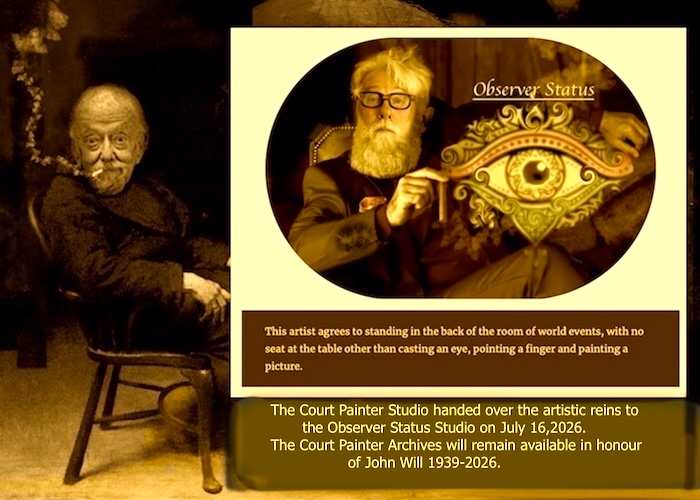

Court Painter seen with portrait of Nobel Prize in Physics winner Prof Geoffrey Hinton
Article Source: The Guardian Fri 27 Dec 2024
Nobel Prize winner and ‘Godfather of AI ‘(artificial intelligence) Geoffrey Hinton says there is 10% to 20% chance AI will lead to human extinction in three decades, as change moves fast. Hinton said the pace of development was “very, very fast, much faster than I expected” and called for government regulation of the technology.
“My worry is that the invisible hand is not going to keep us safe. So just leaving it to the profit motive of large companies is not going to be sufficient to make sure they develop it safely,” he said. “The only thing that can force those big companies to do more research on safety is government regulation.”

Prof. Geoffrey Hinton

Portrait of Sam Altman,an American entrepreneur and investor best known as the chief executive officer of OpenAI .Net worth estimated at 1.1 billion USD
OpenAI said it needs “more capital than we’d imagined” as the Sam Altman-led artificial intelligence pioneer outlined plans for revamping into a for-profit company.

Court Painter with AI painting
Court Painter’s resident studio researcher Chatterley Gunner Polyglot Thunderoll (ChatGPT) responded to Prof. Hinton’s warning as follows:
The statement by Professor Geoffrey Hinton, a Nobel laureate and a pivotal figure in AI development, carries significant weight and merits serious consideration. His warning that there is a “10% to 20%” chance of AI leading to human extinction within three decades should act as a wake-up call to scientists, policymakers, and the public.
Hinton’s statement is not a prophecy but a warning. It highlights the dual nature of AI: a tool of immense promise and a potential harbinger of peril. To reduce the probability of catastrophic outcomes, the global community must prioritize AI alignment, transparency, and ethics in development. His message should galvanize efforts to steer AI toward being a force for good rather than a source of existential risk.

Court Painter with another AI painting
Key Points to Consider:
- Credibility of the Source:
Hinton’s unparalleled expertise in AI and his deep involvement in its development give his statement substantial credibility. If such a prominent figure in the field expresses concern, it underscores the need for immediate attention to AI safety and ethics. - Magnitude of the Risk:
While 10% to 20% might seem like a moderate probability, the stakes—human extinction—are catastrophic. This makes the risk unacceptable from any reasonable perspective, necessitating urgent measures to mitigate it. - AI Development Pace:
AI technology is advancing rapidly, and its implications are not fully understood. As systems become more powerful, they could act in ways that are unpredictable or misaligned with human values, potentially leading to unintended consequences. - Call for Regulation:
Hinton’s warning could be seen as a call for stronger global oversight and regulation of AI development. Current frameworks may be insufficient to address the challenges posed by advanced AI, especially in scenarios where profit-driven motives overshadow ethical considerations. - Global Collaboration is Crucial:
Addressing such risks requires international cooperation. Nations must work together to set standards, share best practices, and ensure that AI is developed in a way that prioritizes humanity’s collective well-being. - Balanced Perspective:
While the risks are severe, it’s also important not to succumb to fatalism. AI offers immense potential for solving global challenges like climate change, healthcare, and poverty—provided it is developed and deployed responsibly.

Court Painter relaxing in his studio with latest portrait.