
Court Painterism in Practice
What does the Court Painter do when he wakes up early in the afternoon? Does he moon over beauty and contemplate the eternal verities? Does he jot down a few bons mots with accompanying illustrations? Does he man the barricades to protest our vulgar, one percenter, consumerist and digital society? Does he pine for the days when artistic men wore knee breeches, silk stockings and tailored smocks?

No, the true Court Painter does none of these things.
The Court Painter goes to his bath and scrubs himself clean, shaves, brushes his teeth, and arranges any stray hairs. Then he adorns himself, examining each detail in his mirror – the dimple in his tie, the shine on his shoes, the puff of his pocket square, the precision of his trouser crease, the tip of his tam,the bloom of his boutonniere, the harmony and balance of all the components of his ensemble – until he gets it just right. When he finally departs his home, he is a habitué not of the salon, opera, theatre, museum, concert hall, casino, restaurant or club to which he may or may not arrive, but to his tailor and haberdasher in advance of his studio.

For Court Painter is a man with visible good taste. Dressing well is his hallmark. Strip the dandy Court Painter of his clothes and what do you have?

Court Painter’s recent history can be summarized in just two albeit Proustian sentences: The definitive study of the portraitist as a social and artistic phenomenon, A Hardon MacKay’s very short essay “The Court Painter: A HUGE Story,” shows how this original, robust, snuff-snorting Inglewood dandy of a painter eschewed the jewel buttons, lace ruffles, silk stockings, gold shoe buckles, perfume and other extravagances of the aristocratic art fop, and also the coarse slovenliness, dirt and disarray affected by Wild rose sympathizers, and instead emphasized superb fit, perfection of cut, harmony of colour, personal cleanliness and, most famously, the well-tied starched linen cravat, and came to dominate his society through his insolence, then crossed the Bow River into Calgary and returned to his Inglewood studio accessorized and sissified in his attire, and became, while remaining a social lion, the more flamboyant “courtly dandy” who eventually drinks too much absinthe, smokes too much hash and Export A’s, rages against the bourgeois art college professors, dressed in black, and thus became the decadent dandy, who spiced his personality with wit and aestheticism, consciously adopted aesthetic garb to match his studio enterprises, entertained the seniors at Tims and just missed becoming the fin-de-siecle Court Painter, who floundered in the shallows of his own shallowness and became a surviving dandy painter and true heir and most insightful interpreter of buddy what’s his name. He became the Bright Young Thing of the early 21st century and one of the charming personages depicted in “Art Oddities of Alberta Revisited,” and fashioned and continues to embody the guiding principle of artist’s studio attire, nonchalant elegance, that has endured for the past three years nine months in Calgary and environs.

But throughout the Court Painter’s many mutations, one constant has persisted: a preeminent political portraitist of the Great Dominion distinguishes himself by the way he dresses inside and outside the studio. Everything else about the Court Painter has been more or less mutable especially his lack of judgement in accepting commissions from those politicians of questionable shelf life.
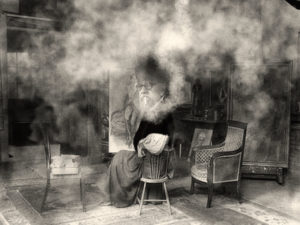
Court Painter needs no explanation, no justification, no interpretation. Instead of analyzing the dandy, we must return to the dandy’s Iowa roots and directly experience with our senses the luminosity of mid western American dandyism itself.

If you must coat Court Painter with some intellectual and artistic veneer, then think of him as an existential hero. In response to the abstract, anonymous, and impersonal international art fairs , he asserts his singular self by never being invited. And, as is his grand tradition, he chooses to assert his superiority in the most frivolous manner possible.
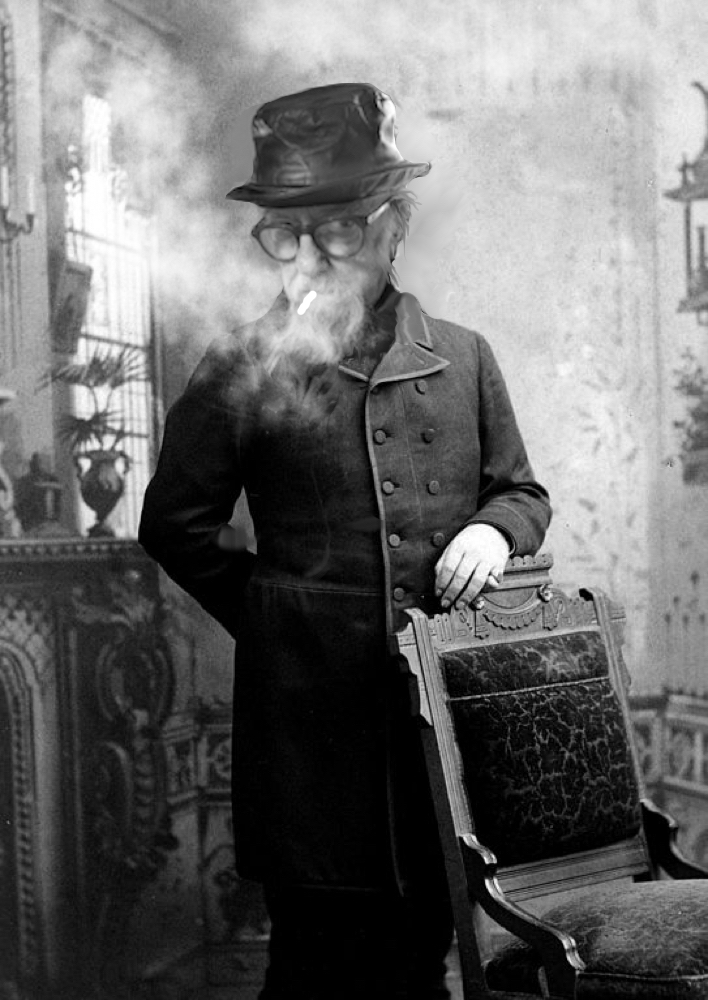
We may prefer to think of Court Painter as a lily of the field. The Bible reads, “Consider the lilies of the field, how they grow; they toil not, neither do they spin. And yet I say unto you, that even Solomon in all his glory was not arrayed like one of these.”

So, dear reader, purge yourselves of philosophical pretensions, emulate the lilies of the field, and ponder life’s most important question:
What will you wear in the studio of life?